


Preoperative Serum Interleukin-6-Based Prediction Model for Early Allograft Dysfunction in Living Donor Liver Transplantation
- Mansoura University, Mansoura, Egypt
- Zoology Department, Faculty of Science, Damietta University, Damietta, Egypt
Abstract
Background: Early allograft dysfunction (EAD) following living donor liver transplantation (LDLT) is strongly associated with graft loss and recipient mortality. Identifying accurate, noninvasive pre- and early postoperative biomarkers is crucial for timely risk stratification. This study aimed to determine the predictive utility of preoperative and postoperative serum interleukin-6 (IL-6) levels, in conjunction with routine biochemical and hematological indices, for the development of EAD in adult LDLT recipients.
Methods: Forty adult patients undergoing LDLT were prospectively enrolled and categorized into non-EAD (NEAD, n = 24) and EAD (n = 16) groups based on standardized Olthoff criteria. Serum IL-6 concentrations and panel parameters—including liver transaminases, bilirubin fractions, albumin, gamma-glutamyl transferase (GGT), and complete blood counts—were quantified on the day prior to surgery (Pre) and on postoperative day 7 (POD-7). Receiver operating characteristic (ROC) curve analysis and binary logistic regression were performed to establish prediction models, with internal validation assessed using 1,000 bootstrap resamples and calibration evaluated via the Hosmer-Lemeshow test.
Results: Serum IL-6 levels were significantly elevated in the EAD cohort compared to the NEAD cohort both preoperatively (10.67 ± 2.77 vs. 8.01 ± 2.98 ng/dL, p = 0.007) and on POD-7 (13.10 ± 4.45 vs. 10.28 ± 3.00 ng/dL, p = 0.034), yielding areas under the curve (AUC) of 0.757 and 0.718, respectively. In univariable logistic regression, preoperative IL-6 was an independent predictor of EAD (odds ratio [OR] = 1.410, 95% CI: 1.058–1.879, p = 0.019), generating a standalone preoperative prediction model [Model 1: Logit(P) = 0.343 × Pre-IL-6 − 3.575] with 75.0% sensitivity, 75.0% specificity, an apparent AUC of 0.7565, and an optimism-corrected AUC of 0.7568. A multivariable postoperative model combining POD-7 direct bilirubin (DB) and albumin (Alb) [Model 2: Logit(P) = 0.403 × POD-7 DB − 4.175 × POD-7 Alb + 10.680] demonstrated high discriminative capacity, with 87.5% sensitivity, 87.5% specificity, an apparent AUC of 0.8776, and an optimism-corrected AUC of 0.8767. Both models showed satisfactory calibration (Hosmer-Lemeshow p > 0.05).
Conclusion: Preoperative serum IL-6 serves as an effective, independent early biomarker for predicting EAD prior to LDLT, offering actionable clinical utility for preemptive donor-recipient risk mitigation. While the postoperative model incorporating POD-7 direct bilirubin and albumin achieved higher statistical discrimination, the preoperative IL-6 model provides distinct clinical value before surgical incision. Furthermore, incorporating postoperative serum albumin into early risk assessments represents a valuable adjunct to existing diagnostic paradigms.
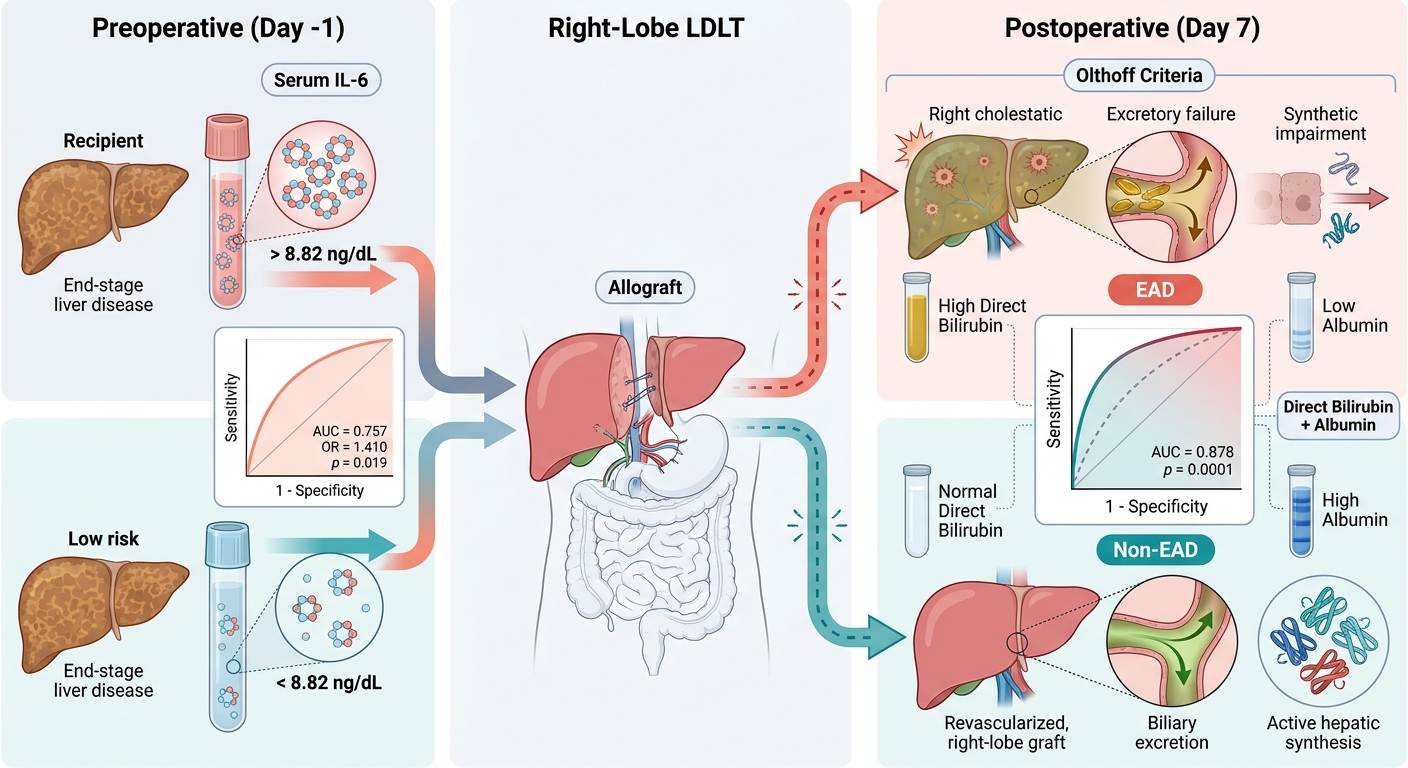
Graphical abstract

Introduction
Liver transplantation (LT) remains the definitive lifesaving therapeutic modality for patients presenting with end-stage liver disease, hepatocellular carcinoma (HCC) within acceptable criteria, and acute liver failure (ALF). Prompt and robust restoration of allograft metabolic, excretory, and synthetic function during the intraoperative and immediate postoperative phases is essential to achieve favorable recipient survival1.
Globally, the persistent scarcity of deceased donor organs has necessitated the expansion of living donor liver transplantation (LDLT). This is particularly evident in Egypt, where historical exposure to schistosomiasis and hepatitis C virus (HCV)—the latter formerly demonstrating a seroprevalence of up to 26%—has produced a considerable burden of advanced cirrhosis and end-stage hepatic disease. Consequently, Egypt accounts for more than 50% of liver transplantations conducted in the Arab region. In accordance with legal and ethical frameworks enacted by the Egyptian Medical Syndicate, adult LDLT has emerged as the principal alternative to overcome deceased donor organ shortages in the country2,3.
Despite progressive refinements in surgical techniques, graft preservation methods, and perioperative intensive care, post-transplant graft insufficiency and primary dysfunction continue to present formidable clinical challenges. Early allograft dysfunction (EAD) represents a well-recognized syndrome of early hepatic malfunction triggered primarily by severe ischemia-reperfusion injury (IRI), microcirculatory disturbances, immunological mismatch, and surgical stress4. Manifesting within the first postoperative week, EAD is strongly associated with acute cellular rejection, biliary and vascular complications, prolonged intensive care hospitalization, and early recipient mortality4,5. Given the common delay in recognizing graft compromise through routine dynamic tests, identifying reliable circulating biomarkers that predict EAD risk before or immediately after transplantation is paramount5.
Cytokines are potent soluble immune mediators that govern systemic inflammatory cascades, leukocyte recruitment, and cell death pathways, functioning as pivotal drivers of both allograft injury and tolerance6. Interleukin-6 (IL-6) is a pleiotropic, pro-inflammatory cytokine produced by vascular endothelial cells, monocytes, and activated macrophages in response to cellular stress, toll-like receptor activation, and tissue damage. It serves as an established prognostic barometer following major abdominal and hepatobiliary interventions7,8. Biomarkers with high sensitivity and specificity are indispensable for early risk detection and clinical decision-making9,10. However, the prospective utility of baseline preoperative circulating IL-6—either alone or incorporated into multivariable models alongside routine hematological and biochemical variables—remains insufficiently defined in LDLT.
Therefore, this study aimed to determine the predictive value of preoperative and postoperative serum IL-6 concentrations alongside standard biochemical and hematological parameters for the occurrence of EAD in adult LDLT recipients. The primary hypothesis was that preoperative serum IL-6 constitutes an independent predictor of EAD. The secondary hypotheses were that multivariable modeling would optimize discriminative power and that incorporating postoperative serum albumin alongside traditional excretory indices would enhance post-transplant risk stratification.
Methods
Ethical Approval and Study Design
This prospective observational cohort study was reviewed and formally approved by the Research and Ethics Committees of the Faculty of Medicine, Al-Azhar University, Damietta, Egypt (Institutional Review Board approval no. DFM-IRB 00012367-23-12-014). All clinical procedures, specimen collections, and data analyses involving human participants were conducted in strict accordance with the ethical tenets of the 1964 Declaration of Helsinki and its subsequent amendments. Written informed consent was obtained from all participants or their authorized legal representatives prior to study enrollment. Consent for specimen acquisition was verified by the attending surgical team.
Study Population and Setting
A consecutive series of 40 adult patients who underwent LDLT at the Gastrointestinal Surgery Center, Faculty of Medicine, Mansoura University, Egypt, were enrolled between December 2023 and July 2024. All surgical procedures involved right-lobe living donor hepatectomies with standard vascular reconstruction and duct-to-duct or Roux-en-Y biliary anastomoses.
Definition of Early Allograft Dysfunction
Recipients were stratified into two clinical cohorts—non-early allograft dysfunction (NEAD, n = 24) and early allograft dysfunction (EAD, n = 16)—according to the standardized, widely validated criteria formulated by Olthoff et al.11. EAD was defined by the presence of one or more of the following parameters: (1) Serum total bilirubin (TB) ≥ 10 mg/dL on postoperative day 7 (POD-7); (2) International normalized ratio (INR) ≥ 1.6 on POD-7; and/or (3) Serum alanine aminotransferase (ALT) or aspartate aminotransferase (AST) > 2,000 U/L within the first 7 postoperative days11.
Exclusion Criteria
Patients were excluded if they met any of the following predefined criteria: pregnancy or women of childbearing potential without verified contraception; advanced or end-stage cardiopulmonary or neurological disorders; severe or irreversible portopulmonary hypertension; active illicit substance abuse; active extrahepatic malignancy (excluding well-differentiated neuroendocrine tumors); active, uncontrolled systemic infection (with the exception of successfully treated spontaneous bacterial peritonitis); requirement for multi-organ transplantation (e.g., combined liver-kidney, liver-heart, liver-pancreas, or multivisceral grafting); severe active psychiatric disorders impairing adherence to immunosuppressive regimens; human immunodeficiency virus (HIV) positivity or acquired immunodeficiency syndrome (AIDS); complete, uncorrectable portomesenteric venous thrombosis; or moribund clinical status with severely restricted life expectancy.
Sample Collection and Specimen Preparation
Venous blood samples were collected from each recipient at two defined timepoints: pre-transplantation baseline (1 day prior to surgery; Pre) and post-transplantation day 7 (POD-7). Each blood sample was divided into two sterile aliquots: the first aliquot was drawn into a plain, additive-free vacuum tube, allowed to clot at room temperature for 30 minutes, and centrifuged at 3,000 rpm for 10 minutes to obtain clear serum for cytokine quantification and biochemical profiles. Serum was immediately separated and preserved at −80°C until batch analysis. The second aliquot was collected in a vacuum tube containing tripotassium ethylenediaminetetraacetic acid (K3-EDTA) for immediate hematological determination.
Biochemical, Hematological, and Cytokine Measurements
Serum IL-6 concentrations were measured in duplicate using a commercial solid-phase sandwich enzyme-linked immunosorbent assay (ELISA) kit (Bioassay Technology Laboratory, Human IL-6 ELISA Kit, Cat. No. E0090Hu, Shanghai, China) following the manufacturer's protocol, with absorbance read at 450 nm on an automated microplate reader. Serum activities of ALT and AST, as well as concentrations of direct bilirubin (DB) and albumin (Alb), were measured using automated spectrophotometric kits (Chemelex, S.A., Barcelona, Spain). Gamma-glutamyl transferase (GGT) activity was determined using the enzymatic rate method described by Szasz12. Complete blood count (CBC) parameters—including hemoglobin (Hb), total red blood cell (RBC) count, white blood cell (WBC) count, and platelet count—were analyzed on a calibrated automated hematology analyzer (Cell-Dyn 1800, Abbott Diagnostics, Abbott Park, IL, USA).
Viral Serological Assays
Serological markers for hepatitis C virus antibodies (HCV-Ab) and hepatitis B surface antigen (HBs-Ag) were detected using standardized third-generation ELISA diagnostic platforms based on solid-phase antibody-antigen binding13. Enzymatic conversion of specific chromogenic substrates was quantified photometrically, with absorbance levels directly proportional to analyte concentration.
Statistical Analysis
Statistical analyses were performed using SPSS version 26.0 for Windows (SPSS Inc., Chicago, IL, USA) and the R statistical computing environment (version 4.6.1; R Foundation for Statistical Computing, Vienna, Austria). Continuous variables were assessed for distributional normality using the Shapiro-Wilk test. Normally distributed variables are reported as mean ± standard deviation (SD) and compared using the independent Student's t-test. Non-normally distributed variables are expressed as median with interquartile range (IQR; 25th–75th percentiles) and compared using the Mann-Whitney U test. Categorical variables are presented as absolute frequencies and percentages [n (%)] and compared between groups using Pearson's chi-square (χ²) test or Fisher's exact test when expected cell counts were less than 5.
Paired temporal comparisons between preoperative baseline and POD-7 measurements within the same cohort were analyzed using the paired Student's t-test or the Wilcoxon signed-rank test, as appropriate. Discriminatory performance was evaluated using receiver operating characteristic (ROC) curve analysis, determining the area under the curve (AUC), 95% confidence intervals (CI), sensitivity, and specificity. Optimal threshold values were established using the maximum Youden's index (J = sensitivity + specificity − 1).
Univariable binary logistic regression was performed to identify independent predictors associated with EAD. Variables reaching statistical significance or marginal clinical relevance (p < 0.10) were considered for multivariable binary logistic regression modeling using forward stepwise selection. To adjust for model optimism and prevent overfitting given the cohort size, internal validation was executed via non-parametric bootstrapping with 1,000 resamples using the rms package in R, generating optimism-corrected AUC/C-index values. Calibration between predicted probabilities and observed outcomes was evaluated using the Hosmer-Lemeshow goodness-of-fit test, with a p-value > 0.05 reflecting satisfactory goodness-of-fit. All statistical tests were two-tailed, and p < 0.05 was considered statistically significant.
Results
Baseline Demographic and Clinical Characteristics
A total of 40 patients undergoing LDLT were included, comprising 24 patients (60.0%) in the NEAD cohort and 16 patients (40.0%) in the EAD cohort. Male recipients predominated in both groups (79.2% in NEAD vs. 93.8% in EAD, p = 0.206). No statistically significant differences were observed between the cohorts regarding recipient age (median 49.50 [IQR: 41.2–57.7] vs. 45.0 [IQR: 28.0–56.0] years, p = 0.411) or body mass index (median 27.5 [IQR: 23.8–31.8] vs. 27.9 [IQR: 21.2–30.4] kg/m², p = 0.356).
All recipients in both cohorts presented with established liver cirrhosis and concurrent chronic cholecystitis. The primary etiologies of liver disease, including chronic HCV infection (45.8% vs. 37.5%, p = 0.601), chronic HBV infection (4.2% vs. 18.8%, p = 0.132), autoimmune hepatitis (16.7% vs. 12.5%, p = 0.718), and secondary hepatocellular carcinoma (16.7% vs. 12.5%, p = 0.718), showed balanced distributions between the NEAD and EAD groups. The prevalence of histological cholestasis (33.3% vs. 18.8%, p = 0.312) and steatosis (12.5% vs. 0.0%, p = 0.141) did not differ significantly. Primary sclerosing cholangitis was identified in two patients (8.3%) in the NEAD group and none in the EAD group (p = 0.236), whereas Budd-Chiari syndrome was documented in one patient (6.3%) in the EAD group and none in the NEAD group (p = 0.215) (Table 1).
Baseline demographic, clinical, and histopathological characteristics of living donor liver transplantation recipients stratified by early allograft dysfunction status.
| Parameter | NEAD Group (n = 24) | EAD Group (n = 16) | p-value |
|---|---|---|---|
| Age (years), median (IQR) | 49.50 (41.20–57.70) | 45.00 (28.00–56.00) | 0.411 |
| Sex (Male), n (%) | 19 (79.2%) | 15 (93.8%) | 0.206 |
| Body Mass Index (kg/m²), median (IQR) | 27.50 (23.80–31.80) | 27.90 (21.20–30.40) | 0.356 |
| Hepatitis C Virus (HCV), n (%) | 11 (45.8%) | 6 (37.5%) | 0.601 |
| Hepatitis B Virus (HBV), n (%) | 1 (4.2%) | 3 (18.8%) | 0.132 |
| Cirrhosis, n (%) | 24 (100.0%) | 16 (100.0%) | — |
| Hepatocellular Carcinoma (HCC), n (%) | 4 (16.7%) | 2 (12.5%) | 0.718 |
| Cholecystitis, n (%) | 24 (100.0%) | 16 (100.0%) | — |
| Cholestasis, n (%) | 8 (33.3%) | 3 (18.8%) | 0.312 |
| Steatosis, n (%) | 3 (12.5%) | 0 (0.0%) | 0.141 |
| Autoimmune Hepatitis (AIH), n (%) | 4 (16.7%) | 2 (12.5%) | 0.718 |
| Primary Biliary Cirrhosis (PBC), n (%) | 24 (100.0%) | 16 (100.0%) | — |
| Primary Sclerosing Cholangitis (PSC), n (%) | 2 (8.3%) | 0 (0.0%) | 0.236 |
| Budd-Chiari Syndrome (BCS), n (%) | 0 (0.0%) | 1 (6.3%) | 0.215 |
Dynamic Trends in Circulating IL-6, Liver Biochemistry, and Hematological Indices
Preoperative and postoperative laboratory parameters are summarized in Table 2. Preoperative serum IL-6 concentrations were significantly higher in recipients who subsequently developed EAD than in those who did not (10.67 ± 2.77 vs. 8.01 ± 2.98 ng/dL, p = 0.007). On POD-7, circulating IL-6 remained significantly elevated in the EAD group relative to the NEAD group (13.10 ± 4.45 vs. 10.28 ± 3.00 ng/dL, p = 0.034). Paired longitudinal analysis demonstrated significant postoperative surges in IL-6 from baseline to POD-7 in both the NEAD cohort (p < 0.0001) and the EAD cohort (p = 0.012).
Comparison of circulating interleukin-6, liver function tests, and hematological indices at preoperative baseline and postoperative day 7 in LDLT recipients with and without EAD.
| Variable | Timepoint | NEAD Group (n = 24) | p2 | EAD Group (n = 16) | p2 | p1 |
|---|---|---|---|---|---|---|
| IL-6 (ng/dL) | Pre | 8.01 ± 2.98 | <0.0001* | 10.67 ± 2.77 | 0.012* | 0.007* |
| IL-6 (ng/dL) | POD-7 | 10.28 ± 3.00 | <0.0001* | 13.10 ± 4.45 | 0.012* | 0.034* |
| Total Bilirubin (mg/dL) | Pre | 2.10 (0.82–3.17) | 0.034* | 1.80 (1.02–3.87) | 0.012* | 0.814 |
| Total Bilirubin (mg/dL) | POD-7 | 3.50 (1.47–6.67) | 0.034* | 6.60 (2.72–9.20) | 0.012* | 0.036* |
| Direct Bilirubin (mg/dL) | Pre | 1.05 (0.22–1.80) | 0.030* | 0.95 (0.62–1.90) | 0.003* | 0.989 |
| Direct Bilirubin (mg/dL) | POD-7 | 2.50 (0.95–4.97) | 0.030* | 5.05 (2.00–7.75) | 0.003* | 0.022* |
| Albumin (g/dL) | Pre | 3.05 (2.52–3.60) | 0.002* | 3.05 (2.80–3.65) | 0.032* | 0.561 |
| Albumin (g/dL) | POD-7 | 3.20 (3.00–3.60) | 0.002* | 2.90 (2.62–3.10) | 0.032* | 0.003* |
| ALT (U/L) | Pre | 23.50 (20.00–47.50) | 0.004* | 23.00 (21.00–61.00) | 0.056 | 0.737 |
| ALT (U/L) | POD-7 | 86.50 (40.20–202.00) | 0.004* | 51.50 (37.50–83.50) | 0.056 | 0.155 |
| AST (U/L) | Pre | 41.50 (22.20–67.50) | 0.529 | 27.50 (24.20–72.70) | 0.114 | 0.771 |
| AST (U/L) | POD-7 | 33.50 (21.20–48.70) | 0.529 | 22.00 (21.00–32.00) | 0.114 | 0.133 |
| GGT (U/L) | Pre | 39.50 (16.50–112.50) | 0.001* | 19.50 (10.70–29.00) | 0.006* | 0.045* |
| GGT (U/L) | POD-7 | 124.50 (68.50–234.20) | 0.001* | 67.50 (40.00–130.00) | 0.006* | 0.031* |
| Hemoglobin (g/dL) | Pre | 10.15 (8.62–11.70) | <0.0001* | 8.95 (8.00–10.32) | 0.012* | 0.112 |
| Hemoglobin (g/dL) | POD-7 | 7.85 (7.20–9.07) | <0.0001* | 7.10 (6.70–7.62) | 0.012* | 0.021* |
| RBC Count (×10&sup6;/μL) | Pre | 3.60 (3.15–3.80) | 0.002* | 3.40 (2.80–4.35) | 0.011* | 0.562 |
| RBC Count (×10&sup6;/μL) | POD-7 | 2.85 (2.52–3.40) | 0.002* | 2.70 (2.50–3.05) | 0.011* | 0.238 |
| WBC Count (×10³/μL) | Pre | 3.40 (2.25–4.30) | 0.006* | 2.45 (2.00–3.77) | 0.001* | 0.042* |
| WBC Count (×10³/μL) | POD-7 | 7.25 (6.22–9.87) | 0.006* | 5.25 (3.12–8.15) | 0.001* | 0.052 |
| Platelet Count (×10³/μL) | Pre | 70.00 (53.40–106.70) | 0.361 | 59.00 (28.70–73.10) | 0.109 | 0.194 |
| Platelet Count (×10³/μL) | POD-7 | 80.20 (45.40–128.70) | 0.361 | 42.00 (27.00–105.50) | 0.109 | 0.059 |
Regarding hepatic excretory and synthetic markers, both total bilirubin and direct bilirubin increased significantly by POD-7 across all recipients (p < 0.05). However, EAD recipients exhibited significantly higher POD-7 total bilirubin (median 6.60 [IQR: 2.72–9.20] vs. 3.50 [IQR: 1.47–6.67] mg/dL, p = 0.036) and POD-7 direct bilirubin (median 5.05 [IQR: 2.00–7.75] vs. 2.50 [IQR: 0.95–4.97] mg/dL, p = 0.022) compared to NEAD recipients. In contrast, while preoperative serum albumin levels were comparable (median 3.05 g/dL in both groups, p = 0.561), POD-7 serum albumin was significantly lower in the EAD group than in the NEAD group (median 2.90 [IQR: 2.62–3.10] vs. 3.20 [IQR: 3.00–3.60] g/dL, p = 0.003).
Preoperative GGT activity was significantly lower in EAD recipients than in NEAD recipients (median 19.5 [IQR: 10.7–29.0] vs. 39.5 [IQR: 16.5–112.5] U/L, p = 0.045). Although both cohorts exhibited pronounced postoperative rises in GGT activity by POD-7, the compensatory surge was significantly blunted in the EAD cohort (median 67.5 [IQR: 40.0–130.0] vs. 124.5 [IQR: 68.5–234.2] U/L, p = 0.031). Transaminase activities (ALT and AST) did not show statistically significant differences between the two groups at either timepoint.
Among hematological indices, preoperative total leukocyte counts were significantly lower in the EAD cohort (median 2.45 [IQR: 2.00–3.77] vs. 3.40 [IQR: 2.25–4.30] × 10³/μL, p = 0.042). Postoperatively, EAD recipients had significantly lower hemoglobin concentrations on POD-7 (median 7.10 [IQR: 6.70–7.62] vs. 7.85 [IQR: 7.20–9.07] g/dL, p = 0.021). Both groups demonstrated expected declines in hemoglobin and RBC counts from baseline to POD-7 (p < 0.05) (Table 2).
Diagnostic Performance and ROC Curve Analysis
The discriminatory accuracy of individual candidate biomarkers was assessed via ROC curve analysis (Table 3). Preoperative serum IL-6 achieved an AUC of 0.757 (95% CI: 0.596–0.917, p = 0.007). At an optimal cutoff threshold of 8.82 ng/dL, preoperative IL-6 yielded a sensitivity of 75.0% and a specificity of 75.0%. For POD-7 IL-6, the AUC was 0.718 (95% CI: 0.541–0.895, p = 0.033), with an optimal cutoff of 11.27 ng/dL providing 71.4% sensitivity and 75.0% specificity.
Receiver operating characteristic (ROC) curve analysis and diagnostic performance of preoperative and postoperative biomarkers for predicting early allograft dysfunction in LDLT recipients.
| Variable | AUC | Cutoff | Sensitivity (%) | Specificity (%) | 95% Confidence Interval | p-value |
|---|---|---|---|---|---|---|
| Pre-IL-6 (ng/dL) | 0.757 | 8.82 | 75.0% | 75.0% | 0.596–0.917 | 0.007* |
| POD-7 IL-6 (ng/dL) | 0.718 | 11.27 | 71.4% | 75.0% | 0.541–0.895 | 0.033* |
| POD-7 Direct Bilirubin (mg/dL) | 0.716 | 4.40 | 62.5% | 70.8% | 0.549–0.883 | 0.022* |
| POD-7 Albumin (g/dL) | 0.781 | 3.05 | 68.8% | 66.7% | 0.640–0.922 | 0.003* |
| Pre-GGT (U/L) | 0.689 | 32.50 | 87.5% | 54.2% | 0.518–0.859 | 0.045* |
| POD-7 GGT (U/L) | 0.703 | 96.00 | 68.8% | 62.5% | 0.541–0.865 | 0.031* |
| POD-7 Hemoglobin (g/dL) | 0.717 | 7.50 | 75.0% | 66.7% | 0.555–0.880 | 0.021* |
| Pre-WBC Count (×10³/μL) | 0.691 | 3.05 | 68.8% | 66.7% | 0.528–0.855 | 0.042* |
Among postoperative clinical chemistry indices, POD-7 albumin demonstrated the highest individual discriminatory capacity (AUC = 0.781, 95% CI: 0.640–0.922, p = 0.003; sensitivity 68.8%, specificity 66.7% at ≤ 3.05 g/dL). POD-7 direct bilirubin demonstrated an AUC of 0.716 (95% CI: 0.549–0.883, p = 0.022; sensitivity 62.5%, specificity 70.8% at > 4.40 mg/dL), and POD-7 hemoglobin yielded an AUC of 0.717 (95% CI: 0.555–0.880, p = 0.021; sensitivity 75.0%, specificity 66.7% at ≤ 7.50 g/dL). Preoperative indices including Pre-GGT (AUC = 0.689, p = 0.045) and Pre-WBC count (AUC = 0.691, p = 0.042) displayed modest predictive utility (Table 3).
Univariable and Multivariable Logistic Regression Modeling
Univariable binary logistic regression revealed significant associations between several candidate markers and EAD development (Table 4). Elevated preoperative IL-6 significantly increased EAD risk (odds ratio [OR] = 1.410, 95% CI: 1.058–1.879, p = 0.019). Elevated POD-7 direct bilirubin was likewise associated with increased risk (OR = 1.356, 95% CI: 1.026–1.793, p = 0.032). Conversely, higher POD-7 albumin conferred strong protection against EAD (OR = 0.038, 95% CI: 0.003–0.446, p = 0.009). Higher POD-7 GGT activity showed a weak, protective association with EAD (OR = 0.990, 95% CI: 0.980–0.999, p = 0.036).
Univariable binary logistic regression analysis of candidate preoperative and postoperative biomarkers associated with early allograft dysfunction.
| Variable | β | Standard Error (SE) | Wald p-value | Odds Ratio (OR) | 95% Confidence Interval |
|---|---|---|---|---|---|
| Pre-IL-6 (ng/dL) | 0.343 | 0.147 | 0.019* | 1.410 | 1.058–1.879 |
| POD-7 IL-6 (ng/dL) | 0.234 | 0.122 | 0.055 | 1.264 | 0.995–1.605 |
| POD-7 Direct Bilirubin (mg/dL) | 0.305 | 0.142 | 0.032* | 1.356 | 1.026–1.793 |
| POD-7 Albumin (g/dL) | −3.263 | 1.253 | 0.009* | 0.038 | 0.003–0.446 |
| Pre-GGT (U/L) | −0.010 | 0.007 | 0.183 | 0.990 | 0.976–1.005 |
| POD-7 GGT (U/L) | −0.011 | 0.005 | 0.036* | 0.990 | 0.980–0.999 |
| POD-7 Hemoglobin (g/dL) | −0.696 | 0.362 | 0.054 | 0.498 | 0.245–1.012 |
| Pre-WBC Count (×10³/μL) | −0.530 | 0.306 | 0.083 | 0.588 | 0.323–1.072 |
Based on multivariable binary logistic regression analysis of significant independent variables, two distinct clinical prediction models were formulated (Table 5):
Model 1 (Preoperative Model): Formulated to enable risk stratification prior to surgical incision based on baseline circulating cytokine levels:
Logit(P) = 0.343 × (Pre-IL-6) − 3.575
Where Pre-IL-6 is expressed in ng/dL. Model 1 demonstrated an OR of 1.410 (95% CI: 1.058–1.879, p = 0.019), an apparent AUC of 0.7565 (95% CI: 0.596–0.917), and balanced sensitivity and specificity of 75.0% at a cutoff of 8.82 ng/dL.
Model 2 (Postoperative Model): Formulated to capture dynamic graft recovery and excretory function at the conclusion of the first postoperative week:
Logit(P) = 0.403 × (POD-7 DB) − 4.175 × (POD-7 Alb) + 10.680
Where POD-7 DB is expressed in mg/dL and POD-7 Alb is expressed in g/dL. Both variables remained independent predictors in multivariable modeling (POD-7 DB: OR = 1.496, 95% CI: 1.032–2.169, p = 0.034; POD-7 Alb: OR = 0.015, 95% CI: 0.001–0.396, p = 0.012). Model 2 achieved high discriminatory performance, with an apparent AUC of 0.8776 (95% CI: 0.762–0.993) and both sensitivity and specificity of 87.5% at an optimal predicted probability threshold of 0.419.
Multivariable binary logistic regression models for preoperative (Model 1) and postoperative (Model 2) prediction of early allograft dysfunction.
| Model Specification | Variable | β | Standard Error (SE) | Wald p-value | Odds Ratio (OR) | 95% Confidence Interval |
|---|---|---|---|---|---|---|
|
Model 1: Preoperative Model | Pre-IL-6 (ng/dL) | 0.343 | 0.147 | 0.019* | 1.410 | 1.058–1.879 |
|
Model 1: Preoperative Model | Constant | −3.575 | 1.523 | 0.019* | 0.028 | — |
|
Model 2: Postoperative Model | POD-7 Direct Bilirubin (mg/dL) | 0.403 | 0.190 | 0.034* | 1.496 | 1.032–2.169 |
|
Model 2: Postoperative Model | POD-7 Albumin (g/dL) | −4.175 | 1.658 | 0.012* | 0.015 | 0.001–0.396 |
|
Model 2: Postoperative Model | Constant | 10.680 | 4.752 | 0.025* | 43477.5 | — |
Model Calibration and Internal Bootstrap Validation
Internal validation of both models was conducted using 1,000 bootstrap resamples to assess model stability and quantify overfitting optimism. For Model 1, the apparent AUC was 0.7565, with an estimated optimism of only 0.0003, resulting in an optimism-corrected AUC of 0.7568 (p = 0.007). For Model 2, the apparent AUC was 0.8776, with an optimism of 0.0009, yielding an optimism-corrected AUC of 0.8767 (p < 0.0001). The negligible optimism values confirm strong internal consistency and minimal over-optimism. Calibration assessment using the Hosmer-Lemeshow goodness-of-fit test demonstrated excellent agreement between predicted and observed EAD events for Model 1 (χ² = 6.456, degrees of freedom [df] = 7, p = 0.488) and Model 2 (χ² = 11.374, df = 8, p = 0.181) (Table 5, Figure 1).

Receiver operating characteristic (ROC) curves and internal validation metrics for preoperative (Model 1) and postoperative (Model 2) prediction models of early allograft dysfunction in living donor liver transplantation. Receiver operating characteristic (ROC) curves comparing the discriminatory performance of the preoperative prediction model (Model 1, blue line) and the postoperative prediction model (Model 2, red line) for the occurrence of early allograft dysfunction (EAD) in 40 adult living donor liver transplantation (LDLT) recipients. Patients were classified into non-EAD (NEAD, n = 24) and EAD (n = 16) cohorts according to Olthoff criteria. Model 1 was constructed using baseline preoperative serum interleukin-6 (Pre-IL-6, ng/dL) measured via sandwich ELISA on the day prior to transplantation [Logit(P) = 0.343 × Pre-IL-6 − 3.575]. Model 2 was constructed by combining serum direct bilirubin (DB, mg/dL) and serum albumin (Alb, g/dL) measured on postoperative day 7 (POD-7) via automated clinical chemistry [Logit(P) = 0.403 × POD-7 DB − 4.175 × POD-7 Alb + 10.680]. Internal validation was performed using non-parametric bootstrapping with 1,000 resamples to quantify optimism and compute optimism-corrected area under the curve (AUC) values. Model 1 exhibited an apparent AUC of 0.7565 (95% CI: 0.596–0.917) and an optimism-corrected AUC of 0.7568, achieving 75.0% sensitivity and 75.0% specificity at an optimal cutoff of 8.82 ng/dL (p = 0.007). Model 2 demonstrated superior statistical discrimination, with an apparent AUC of 0.8776 (95% CI: 0.762–0.993) and an optimism-corrected AUC of 0.8767, achieving 87.5% sensitivity and 87.5% specificity at a predicted probability cutoff of 0.419 (p < 0.0001). Both models demonstrated minimal performance optimism (≤ 0.0009), verifying excellent internal stability. Blue curve: Model 1 (Pre-IL-6); Red curve: Model 2 (POD-7 DB + Alb); Green diagonal line: reference line of no discrimination (AUC = 0.50). Diagonal segments are produced by ties.
Discussion
Living donor liver transplantation (LDLT) is a crucial therapeutic intervention for patients with end-stage cirrhosis, acute liver failure, and selected hepatic malignancies14. Nevertheless, early allograft dysfunction (EAD) remains a severe clinical challenge characterized by impaired hepatocyte integrity, defective biliary excretion, and compromised protein synthesis within the immediate post-transplant period15. Clinically, EAD significantly elevates the risk of graft loss, septic complications, and recipient mortality16. Consequently, identifying reliable, noninvasive prognostic biomarkers that facilitate early risk stratification is vital to optimize perioperative management and enhance graft and patient survival15,17.
Although the complex pathophysiological mechanisms underlying EAD remain incompletely defined, allograft dysfunction is primarily driven by hepatic ischemia-reperfusion injury (IRI) and subsequent systemic inflammatory responses. Pre-existing recipient systemic inflammation, often secondary to portal hypertension, bacterial translocation, and cirrhosis-associated immune dysfunction, amplifies postoperative microvascular collapse and allograft injury following LDLT16. Circulating inflammatory mediators are pivotal in reflecting underlying disease severity, steering therapeutic interventions, and monitoring clinical recovery18. In this context, IL-6 serves as a key pro-inflammatory cytokine that orchestrates acute-phase responses, immune cell trafficking, and tissue injury across various autoimmune, malignant, and critical illnesses19. Furthermore, elevated circulating IL-6 has been documented as an accurate prognostic indicator of major adverse events and surgical complications following complex hepatobiliary and abdominal surgery8,20.
In the present study, serum IL-6 concentrations were significantly elevated in patients who developed EAD compared to those with uneventful graft function, both preoperatively (10.67 ± 2.77 vs. 8.01 ± 2.98 ng/dL, p = 0.007) and on POD-7 (13.10 ± 4.45 vs. 10.28 ± 3.00 ng/dL, p = 0.034). Preoperative IL-6 demonstrated robust standalone discriminatory performance (AUC = 0.757; 75.0% sensitivity and specificity) and was independently associated with EAD development (OR = 1.410, 95% CI: 1.058–1.879, p = 0.019). These findings corroborate earlier investigations showing a direct correlation between pre-transplant cytokine activation and post-transplant allograft dysfunction21. This elevated baseline cytokine milieu likely reflects the interplay of subclinical endotoxemia, innate immune priming, and hepatic fibrosis22. Moreover, baseline circulating IL-6 has been implicated in the pathogenesis of post-transplant acute kidney injury and acute rejection episodes, underscoring its utility as an early systemic warning marker23,24.
Serum albumin, exclusively synthesized by functional hepatocytes, is the principal determinant of plasma oncotic pressure and plays an essential physiological role in preventing interstitial fluid extravasation, ascites formation, and pulmonary edema. Additionally, albumin acts as an endogenous carrier for diverse ligands, scavenges reactive oxygen species, buffers plasma pH, and exerts mild anticoagulant properties25. Profound postoperative hypoalbuminemia is frequently observed after major surgical stress and liver transplantation, functioning as an established predictor of adverse clinical outcomes26. In our cohort, EAD recipients exhibited significantly lower serum albumin concentrations on POD-7 than NEAD recipients (median 2.90 vs. 3.20 g/dL, p = 0.003). A low POD-7 albumin level demonstrated substantial discriminatory accuracy (AUC = 0.781) and a pronounced univariable association with EAD (OR = 0.038, 95% CI: 0.003–0.446, p = 0.009). These results align with previous observations where acute perioperative albumin decrements reflected heightened systemic capillary permeability, systemic inflammatory response syndrome (SIRS), and prolonged hospitalization following major abdominal surgery27,28,29. Although Lichtenegger et al. reported that perioperative albumin levels alone were not independently associated with long-term survival in deceased donor liver transplantation30, our data indicate that early postoperative albumin recovery directly mirrors allograft synthetic capacity in living donor grafts, confirming its relevance in short-term functional recovery31.
Bilirubin kinetics represent an indispensable diagnostic pillar for monitoring hepatic excretory and clearance functions32. Persistent hyperbilirubinemia during the first post-transplant week is a classic component of the Model for End-Stage Liver Disease (MELD) and standard EAD criteria, serving as a reliable predictor of acute cellular rejection, ischemic cholangiopathy, and primary non-function33,34. In our study, EAD patients displayed significantly higher concentrations of both total and direct bilirubin on POD-7 (p = 0.036 and p = 0.022, respectively). Direct bilirubin on POD-7 independently predicted EAD (AUC = 0.716, OR = 1.356, p = 0.032). Immediate post-transplant bilirubin excretion reflects hepatic microcirculatory perfusion and the severity of cold and warm ischemia35,36,37. Furthermore, delta bilirubin (albumin-bound conjugated bilirubin) accumulates proportionally during sustained cholestasis and has been identified as an early discriminator of acute allograft rejection38.
Serum GGT activity is conventionally recognized as a sensitive biomarker of biliary epithelial stress and cholestasis, functioning as a prognostic determinant in primary biliary cholangitis and related chronic cholestatic conditions39. Interestingly, our study revealed that preoperative and POD-7 GGT activities were significantly lower in the EAD cohort compared to the NEAD cohort (median 19.5 vs. 39.5 U/L preoperatively, p = 0.045; median 67.5 vs. 124.5 U/L on POD-7, p = 0.031). Although GGT elevation is traditionally viewed as a sign of hepatobiliary injury, transient early postoperative GGT elevation after liver resection and transplantation has been shown to reflect active hepatocyte regeneration and glutathione-dependent antioxidant resynthesis. Our findings strongly corroborate the paradigm established by Alkozai et al.40, who demonstrated that early elevated postoperative GGT after liver transplantation is paradoxically associated with superior graft and patient survival. In our cohort, the robust rise in GGT observed in NEAD recipients reflects intact regenerative capacity and metabolic adaptation against ischemia-reperfusion injury, whereas suppressed GGT dynamics in EAD recipients reflect blunted physiological recovery40.
By integrating these candidate biomarkers through binary logistic regression, we developed two distinct prediction models. Model 1 relies on baseline Pre-IL-6 [Logit(P) = 0.343 × Pre-IL-6 − 3.575], delivering an AUC of 0.757 with 75.0% sensitivity and specificity. Model 2 combines POD-7 direct bilirubin and serum albumin [Logit(P) = 0.403 × POD-7 DB − 4.175 × POD-7 Alb + 10.680], yielding superior statistical discrimination with an AUC of 0.876 and 87.5% sensitivity and specificity. Crucially, internal validation using 1,000 bootstrap resamples confirmed negligible performance optimism (0.0003 for Model 1 and 0.0009 for Model 2), verifying high model stability and absence of meaningful overfitting despite the sample size. Goodness-of-fit testing confirmed excellent calibration across both models.
A key strength of this study lies in providing two complementary predictive models tailored to different clinical windows. The preoperative model offers distinct clinical utility by enabling risk stratification prior to surgery, thereby facilitating targeted donor-recipient matching, preconditioning strategies, and heightened intraoperative vigilance. Conversely, the postoperative model provides superior statistical discrimination at POD-7, introducing serum albumin as an easily accessible, objective biomarker that adds incremental synthetic dimension to standard excretory criteria9.
Several study limitations should be acknowledged. First, the sample size was relatively small (n = 40), reflecting single-center recruitment over an eight-month window. Nonetheless, the stability of the models was rigorously demonstrated via bootstrap internal validation with minimal optimism. Second, the single-center setting necessitates caution when extrapolating these findings to broader, multi-ethnic cohorts or deceased donor transplantation programs. Future large-scale, multicenter prospective investigations are warranted to externally validate these prediction models and explore their integration into clinical decision-support algorithms.
Conclusion
This study established two robust prediction models for early allograft dysfunction in living donor liver transplantation. The preoperative model based on serum IL-6 provides actionable clinical utility by identifying high-risk recipients before surgical incision, facilitating preemptive therapeutic and perioperative optimization. The postoperative model combining POD-7 direct bilirubin and albumin exhibits excellent statistical discrimination and internal stability, establishing serum albumin as a valuable novel adjunct to standard diagnostic criteria for post-transplant graft monitoring.
Declarations
Abbreviations
AIH: autoimmune hepatitis; Alb: albumin; ALF: acute liver failure; ALT: alanine aminotransferase; AST: aspartate aminotransferase; AUC: area under the receiver operating characteristic curve; B: unstandardized regression coefficient; BCS: Budd-Chiari syndrome; BMI: body mass index; CBC: complete blood count; CI: confidence interval; DB: direct bilirubin; DDLT: deceased donor liver transplantation; df: degrees of freedom; EAD: early allograft dysfunction; ELISA: enzyme-linked immunosorbent assay; GGT: gamma-glutamyl transferase; Hb: hemoglobin; HBs-Ag: hepatitis B surface antigen; HCC: hepatocellular carcinoma; HCV: hepatitis C virus; HCV-Ab: hepatitis C virus antibody; HIV: human immunodeficiency virus; INR: international normalized ratio; IQR: interquartile range; IRI: ischemia-reperfusion injury; LDLT: living donor liver transplantation; LT: liver transplantation; MELD: Model for End-Stage Liver Disease; NEAD: non-early allograft dysfunction; OR: odds ratio; PBC: primary biliary cirrhosis/cholangitis; POD: postoperative day; POD-7: postoperative day 7; Pre: preoperative baseline (day prior to transplantation); PSC: primary sclerosing cholangitis; RBC: red blood cell; ROC: receiver operating characteristic; SD: standard deviation; SE: standard error; SIRS: systemic inflammatory response syndrome; SPSS: Statistical Package for the Social Sciences; TB: total bilirubin; WBC: white blood cell.
Acknowledgments
None.
Author’s contributions
None.
Funding
This research received no external grant or funding from public, commercial, or not-for-profit agencies. The study was entirely self-funded by the authors. No honorarium or other financial support was provided to produce this manuscript.
Availability of data and materials
The datasets generated and analyzed during the current study are available from the corresponding author upon reasonable request.
Ethics approval and consent to participate
The study protocol was reviewed and approved by the Research and Ethics Committees of the Faculty of Medicine, Al-Azhar University, Damietta, Egypt (Approval No. DFM-IRB 00012367-23-12-014). All clinical procedures and investigations were conducted in compliance with the ethical guidelines of the 1964 Declaration of Helsinki and its subsequent revisions. Written informed consent was obtained from all patients or their legal representatives prior to enrollment.
Consent for publication
None.
Declaration of generative AI and AI-assisted technologies in the writing process
None.
Competing interests
The authors declare that they have no competing interests.